
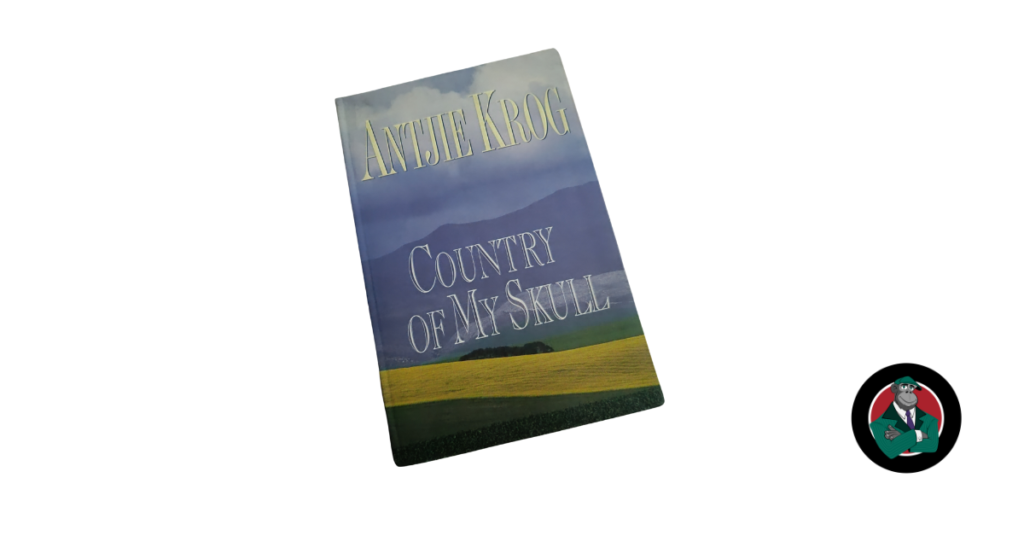
You could say that this book is an account of what occurred during the Truth and Reconciliation Commission in South Africa during the 1990’s. But it is much more than that. The author cannot extricate themselves from the reality they occupy and with grace Antjie Krog acknowledges that fact. Much of the book comes from testimony and records that were kept by the journalists covering this advent.
I was a youngster when the Truth commission happened. I didn’t understand its existence let alone its meaning or significance. But now I can appreciate the magnitude of the undertaking. The sheer scale of the task was monumental. To uncover the truth that has been hidden and made murky by so many bad actors who were good at what they did. From all sides. Nobody leaves the scene unscathed or innocent. Even the innocents have their innocence destroyed.
Was it a success? I’m not sure. The definition of success must be worked out. It happened. Perhaps that is enough. Perhaps it is not. There is too much to uncover within oneself to know the truth about the truth commission. Rather know thyself. Honestly. Don’t believe the myths and magic that you’ve been conditioned to believe.
“A myth is a unit of imagination which makes it possible for a human being to accommodate two worlds. It reconciles the contradictions of these two worlds in a workable fashion and holds open the way between them. The two worlds are my inner and outer world. Myth makes it possible to live with what you cannot endure. And if the myth has been learnt well it becomes a word. A single word that switches on the whole system of comforting delusions.”
Too many myths propped up the house of Apartheid. Too many people still believe in these myths. Nowadays even the Truth commission is mythological. Even though many people didn’t engage with it in any meaningful sense, they expect the crucifixion of others to cleanse their own sins. A typical Christian standpoint. But to save your own soul you need to face the fire. Nobody can know the truth for you. You have to know it, understand it, believe it for yourself. That means facing the facts, not filling your head with flights of fancy about where you are or who you are. Keep it real.
It is difficult to highlight any particular part of this book. All of it is searing. While it may be simpler to retell the horrors (of which there are multitudes) I will take the path of hope and look to certain topics that may not be commonly associated with the TRC (this acronym has wrung out much of the meaning behind the Truth commission and left many people with the impression that it was a hollow process like this hollow label).
“The basis of shame is honour. Honour functions when the image a person has of himself is indistinguishable from that presented to him by other people. The ethos of honour is opposed to a morality which affirms the equality in dignity of all people and consequently the equality of their rights and duties. In a society in which honour is the keystone of the values, any choice other than that imposed by the code of honour is unthinkable, and it is at the moment of choice that the pressure of the group is at its strongest.”
Humans typically view honour as a positive attribute. However, it is clear that honour can cause great shame. Actions taken in the name of honour can, in a wider context, be shown as grave mistakes and outright injustice. Legality is not synonymous with morality. The law aims to be the arbiter of wrong and right, good and evil, but it is a human-made element and so it is as flawed as its creator. Laws are not inherently just. The project of Apartheid specifically highlights that evil can be codified in law and executed by the state with relative impunity. Beware the society that is based on honour rather than humanity. Humanity is one of the few things the human race has going for itself.
“Against a flood crashing with the weight of a brutalising past on to a new usurping politics, the Commission has kept alive the idea of a common humanity. Painstakingly it has chiselled a way beyond racism and made a space for all our voices. For all its failures, it carries a flame of hope that makes me proud to be from here, of here.”
Imperfect as the Truth commission may have been, it took on a monumental task and provided South African society with the context for real recovery by acknowledging the brutal facts of reality. Under the guidance of the magnanimous Archbishop Desmond Tutu. Every once in a while a great person lives their life for the good of the world and he was one such human. To manage the Truth and reconciliation commission as he did took the qualities of a saint. Most mortals would have bayed for blood and guts. Keeping the fires of violence burning for life.
Violence is still an issue in SA. There is much healing still to be done. There is much hatred still causing havoc. But this book and the events it covers show the stark reality that hope is possible, even in the face of unrelenting brutality.
There is much that can be written and said about Country of my skull but Andre Brink probably said it best: “Trying to understand the new South Africa without the Truth and Reconciliation Commission would be futile; trying to understand the Commission without this book would be irresponsible.”

