
Understanding humans is such a tricky and tedious task. I guess that’s why most of you are wandering around lost and alone, confused and crying at the injustice of existence as you see it. It seems plain to me that most people are more related to their persona than their actual selves. But knowing yourself, not your name, not your history, not your narrative, but your actual true self, has been an endeavour that some of the smartest humans in history have undertaken. Ever since your collective level of consciousness as a species increased to the point where those endeavours were even a possibility, some of the intelligent humans asked good questions and found good answers.
Of course the ones who wrote it down get the most props nowadays, which is why Plato and Aristotle were such a big hit in the philosophy scene for Western civilisation. The same goes for Lao Tse in the East. Unfortunately there weren’t many written languages in Africa and the Americas, which were advanced enough to elucidate this level of ideation, however, the worldviews intrinsic in those parts of the world were vastly different from those purported in Europe. No less valid, possibly even more useful in today’s world, where the interaction of varying worldviews are few where the outcome doesn’t end in violence.
Understanding yourself is vital if you’re ever to understand anything that is not you. Even the sense data that you receive through your eyes, ears and various neurons can be corrupted. The brain that translates it all can be corrupted. Yet, from your personal perspective, your experience will be the truth for you. Even though certain concepts can’t even be conceived of (like how a blind person can’t conceive of colour, because they can’t experience it, and then we use the names for colours metaphorically and literally, which just fucks it up even more for them) the fact is that from their position, their experience, they develop a worldview that they come to know as true.
The intelligent humans among the throng of ignorant masses understand that each person has their own perspective and no one is more true than the other. Real reality is somewhere in between what we all call experience. To find it out takes honest communication between observers and an ever open mind to the unexplained. Call it curiosity with a sprinkle of imagination. You humans came up with the scientific method for this very purpose (to find the truth about reality), but quite a lot of you have abandoned this tool for something much stupider, blind faith. Faith ain’t bad, but blind faith is brutally destructive.
But back in the early 20th century the value of science was highly appreciated and applied to new schools of thought. One of these schools was psychology. Again it came down to who wrote about it first for someone to become inextricably tied to the concept. Most folks think of early psychological studies being embodied in one fella: Sigmund Freud. But there were folks before him who sought to analyse and understand the human psyche (although they probably didn’t call it that) in order to relieve individuals and society of the ills associated with a disturbed mind (although they probably didn’t see it like that).
Back when humans were first developing the ability to write they had an understanding of physics and the outside world in practical terms. Like other animals wandering the planet they navigated it through the manipulation of the outer world, however, the true power comes from knowing and embracing the inner world.
Ancient religious ceremonies and cultural rites of passage often have a very psychological tinge to their performance. Sangoma’s in South Africa need not diagnose you with the use of a stethoscope but they can do it through rolling the bones and analysing your social circumstances to diagnose the roots of your problems. Psychoanalysis is not new but this name for it was, and being so meticulous in fleshing the study out turned it into a fully fledged science.
There was another fella who came to make an impact on psychotherapy who had a very different approach to Freud. Carl Gustav Jung (often called CG, like an OG) studied under Freud but came up with different theories. For many years he worked building up these theories to withstand the sort of scientific scrutiny that was expected and experienced by academics at that time – particularly in ‘new’ sciences. He didn’t think they were particularly useful to regular people because they were aimed for an audience of uptight academics.
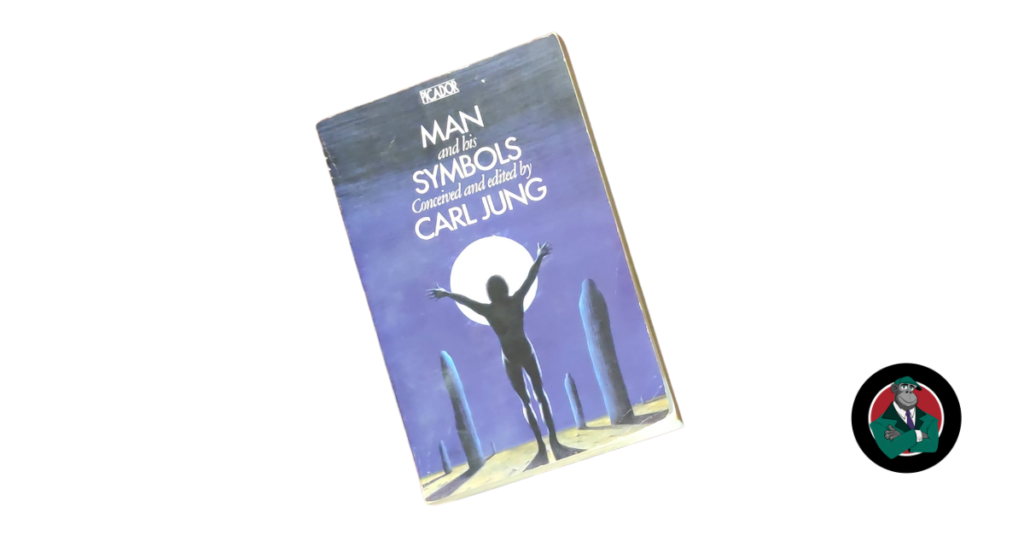
Later in life he did an interview and afterward the interviewer approached him to write a book targeted at the general masses. At first he declined, but after having a dream, he changed his mind. The book they wrote was called Man and his symbols. CG was quite old at this point and his theories had been taken up by others who he decided had a good enough grasp of the idea to write about it rather than him. He died soon after completing his chapter. The dream Jung had about it turned into a great example for him to explain his theories.
To be honest, they make remarkable sense and align with the thinking of other impressive people I’ve read like Jiddu Krishnamurti and Alan Watts. The overlap between Jung’s ideas and those of Eastern religious thought was also intriguing. I was reminded of the words Alan Watts recorded while lecturing on his houseboat, around the same time this book was published.
After reading this book I felt immensely more equipped to understand not only myself as a self-conscious being, but also all of you humans running around seemingly without a clue as to who, WHO, you really are. Like that song by The Who. It’s a challenge to ‘know thyself’. A catchier version of the Delphic catchphrase “Know Thyself” (made famous by Plato I believe). And now we have so many more answers than ever before, but you’ve got to be sure not to pick up shit. There’s a lot of it out there. Bukowski would bawl or brawl about it if he saw it all. I’m shining a light on this book saying this one sparkles. It’s a diamond not a turd. If you’re only ever going to read a few books in your life, I’d recommend this to be one of them.

