
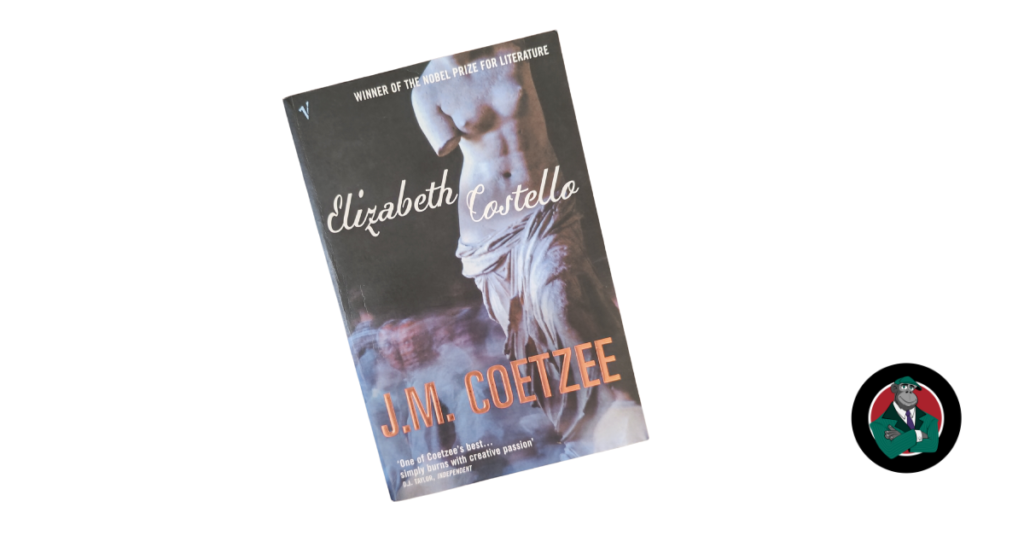
Having read Disgrace and Waiting for the barbarians when I opened this book I half expected another soul crunching experience. Classic Coetzee realism mixed with circumstances that make the characters engage in the kind of behaviour that usually makes one cringe or cry. I was pleasantly surprised when Elizabeth Costello turned out to be a vastly different kind of story.
The book follows the title character as she goes around the globe giving lectures as a well-known and respected writer. Her homilies are often a diversion from the topic at hand and drive into the deep ethics of animal welfare. Particularly those animals that are reared to be eaten. As an omnivore myself, I was amazed at the level of awareness that arose within my psyche as this Costello woman shared her thoughts on the matter extensively.
Obviously she is a vessel for the author to showcase his beliefs but she is a fine container for the cause. My ape sensibilities appreciated such empathy for non-humans from a human. I have thought about the ethics involved with factory farming and it seems a simple conclusion if one uses reason. The practice is barbaric. Smaller scale operations with ethics and care at the core of their organisation, rather than profit, is a far more sustainable and morally acceptable path.
I know better than to step between a meat eating human and their fleshy feast so I’ll leave it to Coetzee and Costello to make the arguments. They’re likely much better than anything I could muster. But the story isn’t only about animal rights and wrongs but also the ways you humans engage with each other. Particularly when you share a fair amount of DNA and call each other names like mother and son.
These labels of familiarity can make for interesting dilemmas in how you each construct a worldview. Adding hidden values and deep connotations to certain words that quickly skew your perspective way beyond what is useful to understand reality. Elizabeth Costello seems to express certain stoic principles in her views on human life, including growing old, but the ethical edge over shadows.
Her talks become the primary performance and they can be astounding. Personally I appreciated the part where she talks about Red Peter, the ape of Franz Kafka’s ‘A Report to an Academy’. I have yet to read that piece but I researched the character and story and obviously felt a kinship. I am the progeny of Red Peter. Although you humans draw many metaphorical conclusions from the story my engagement is primarily biological. I can identify with that ape who came to learn how to be human. That is my story too.
I have no doubt you humans will easily analyse this fact into meaningless oblivion so I’ll stop writing about it there. I am not as devoted to arguing with you lot as much as the Costello woman is. And I don’t believe I could trust most of you to move past your fine tuned prejudices enough to understand the perspective from my point of view. I think the stories about humans might move you further than my ape-man-like existence. Elizabeth Costello would not be a waste of your time to read. As a human you’ll probably appreciate the tensions between tatamae and honne that come from being one of the lucky few to actually be alive.

