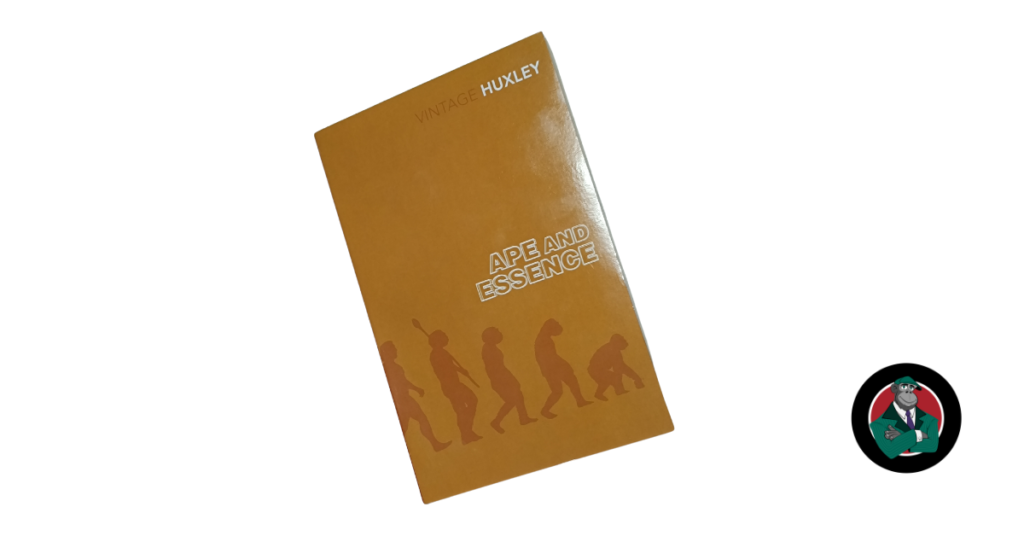
This is a fairly brief book at 153 pages but it’s quite powerful. Aldous Huxley is a renowned author but it is his later works that have come to signify how he is seen in the world that came to be after his life ended. Ape and Essence may not be as famous as his other works but it is not to be overlooked.
The narrative begins with some Hollywood execs looking for the writer of a script that they have come upon. This feature likely stems from Huxley’s life in California when he dabbled in scriptwriting. The execs find a house filled with a few people but not the script’s writer: he’s dead. The rest of the book is the script itself.
The story in the script takes place in the future. In a world where the third world war and a nuclear holocaust and winter have taken place. Immediately imagery of apes in human affectations. Jack-booted baboons lead Einsteins around on leashes. The scene is set with wonderful word wizardry: “When Ignorance was merely ignorance, we were the equivalents of lemurs, marmosets and howler monkeys. Today, thanks to that Higher Ignorance which is our knowledge, man’s stature has increased to such an extent that the least among us is now a baboon, the greatest and orangutan or even, if he takes rank as Saviour of Society, a true Gorilla.” (pg. 26)
The Higher Ignorance of knowledge has driven the human race to the edge of extinction in this story. “Or can it be that you have forgotten that you have never even discovered what lies beyond the mental Zoo?” (pg 27). The signs of impending destruction are emblazoned on the familiar flags of nations that have ceased to exist. “Vertical stripes, horizontal stripes, noughts and crosses, eagles and hammers. Mere arbitrary signs. But every reality to which a sign has been attached is thereby made subject to its sign.” (pg 29). The understanding of reality has been subordinated to the misunderstanding of the self. Everyone looks at the finger and calls it the moon. Human life has degraded to the point of apehood and we chose the course of action: “Bread for the body and bread for the spirit. Our choice is between bread and bunting. And bunting, I need hardly add, is what we have almost unanimously chosen.” (pg 30).
The only remaining location on Earth where some semblance of life as we know it, and dream it to be, exists in New Zealand, where the nuclear fallout would have had the least effect. From the islands of Aotearoa a group of scientists set out to rediscover the West, landing in California. The media Mecca has burnt almost completely to the ground as wild men run amok in their version of a society.
This society as depicted by Huxley could serve as a valid inspiration for the world-making mind of George Miller. Horror and desolation are the order of the day. Cemeteries are mined for value as the Earth itself has become barren. How could humans reach such a result? His ape-mind is what old Aldous has his fictional scriptwriter (Mr Tallis) call the reason: “Ends are ape-chosen; only the means are man’s.” (pg 32). The destruction and decimation seem to be part of human DNA. Even with advanced technology and knowledge the underlying forces of the human mind drive even the most sophisticated action toward the most grotesque end.
“Church and state,
Greed and hate:-
Two Baboon-persons in one Supreme Gorilla.” (pg 33).
The brutality and literal devil-worship seemingly come as no surprise to those pathetic vestiges of human life who survived the nuclear holocaust (The Thing as they call it – a name that illustrates their lack of comprehension which we should all expect should we find ourselves alive after Armageddon). Their priests and chiefs see their world for what they proclaim it to be and create obscene social structures that maintain their status quo. Much like the leaders of all times and places. But in this time, in this place, terror is very much the theme. Women and mother’s become the scapegoats for society’s ills. Particularly the deformed progeny that are the fruits of their wombs. Babies born with deformities that even these demons of people find disgusting. Killing them like Spartans to keep any semblance of healthy biological fecundity. Both for the people and their environment.
The choices of society in the past is what leads to this future and those choices are fuelled by fear. “There is no longer a man among his fellow-men, no longer a rational being speaking articulately to other rational beings; there is only a lacerated animal, screaming and struggling in the trap. For in the end fear casts out even man’s humanity. And fear, my good friends, fear is that basis and foundation of modern life.” (pg 37). Here the sweet scent of Huxley’s mysticism can be held. As fear is undoubtedly a core source of human suffering and there is only one antidote. “Love casts out fear; but conversely fear casts out love. And not only love. Fear also casts out intelligence, casts out goodness, casts out all thought of beauty and truth.” (pg 36-37).
I enjoyed this book and although much of it may be somewhat depressing, overall the allegorical style offers a chance for the humans of today – that time before the nuclear holocaust – to revisit the value of their knowledge and belief. A chance to take back a future as inevitable as a parasite killing its host. How do we avoid that future? Huxley offers a line that might match the phrase so often associated with the Oracle of Delphi (“Know thyself”):
“Only in the knowledge of his own Essence
Has any man ceased to be many monkeys.” (pg 55)

