Growing up in the middle class suburbs of South Africa amidst the angsty white youth I was introduced to punk rock through an older brother. He sourced various cover songs of old classics sung and played in the raunchy and rough style of punk, but there were a few bands and albums that were quickly introduced to me and that no doubt helped my indoctrination into the subculture. Before I hit double digits in years on this earth I had listened to one particular album more times than I had orbited the sun: The Offspring’s Smash.
On one family road trip with a brand new CD player we forgot to pack any other CDs and so we listened to Smash on repeat. Even the hidden track at the end revealed itself. The lyrics and melodies are burned into my memory. I never noticed the little ‘E’ logo on the bottom corner of the back sleeve though. I understood that writing their own songs made them better than other bands. Although there was one song on the album that wasn’t written by the band themselves, which I was aware of because I enjoyed it and was swiftly browbeaten back into my corner of poseur as the elder punks taught me the lesson. The song was Killboy Powerhead. I kinda thought it was my song.
Anyway, fast forward a few years and in the second year of highschool I made a friend who had an older brother who worked in America for a while. One night while walking home he noticed a show on and decided to check it out. The band playing was called Bad Religion. Although he paid to enter, he decided not to stay because they were “a bit hard for his taste”. This word of their legend reached our ears through this story and in all our teenage rage we went searching for their songs.
Luckily we were aided by having access to the internet, although the speed was incredibly slow back then, 56K modems. We used tools like Napster, Soulseek and Limewire to find the songs we so eagerly sought. This was because we didn’t have the money to buy them, but also because they weren’t readily available in any music stores on this wedge of Africa. To be fair, most of the African market doesn’t really display high demand for punk rock but there are always enclaves.
Our ability to find new music was exacerbated by the advent of internet access at school. Only to those who did computer science, but that didn’t stop us from sneaking friends in to help load a list of songs into the desired program and then turn off the monitor, but not the computer. This was ideally done on a Friday afternoon during the final period, so that the downloads could run over the entire weekend, non-stop. That way, on Monday morning we could have up to 5 new songs to listen to.
The first Bad Religion song I ever heard was Infected. I thought it was great. Not really that hard, but I could see how someone who preferred genres other than punk may find it not that soft. The lyrics and moody music give it an edge. But my buddy insisted there had to be harder songs out there. His brother wouldn’t have left because of Infected. So we continued to search. This was in the early 21st century so we were able to dig up quite a few songs of what was already an impressive discography.
Like some kind of audiological archaeologists we unearthed single song tracks that then pointed to an album. We’d use search engines to help find whatever information we could. There wasn’t much back then but there always seemed to be more and more every day, month and year. The internet was still growing but it grew at pace.
Soon we had unearthed a whole discography from How Could Hell Be Any Worse? To Suffer, No Control, Generator, Stranger Than Fiction, Against The Grain, Recipe for Hate, The Gray Race, No Substance and The New America. Although we may not have fleshed out the entire albums in our escapades on the internet, soon enough our luck reached fever pitch and we found an actual CD in a music store. It was the biggest in the area with the largest import section.
That day my friend bought The Process of Belief. We hadn’t heard it before and we sat at the McDonald’s waiting for our parental transport, reading the lyrics in the booklet like monks studying a parable. We learned about oozin’ ahhs for the first time. We sat consuming the artefact like ticks on a fat puppy. Engorging our minds on the writing and artistry. The lyrics made you question your vocabulary and had us reaching for a dictionary on many occasions. But this was not a chore, this was part of the unravelling of the codes within which the world had been explained to us. It was a codex to making sense of the world without doctrine or dogma.
By the time The Empire Strikes First came out we were in the stream with current releases. That album will always have a special place in my heart because it was made in my time. That was the first time I heard a Bad Religion song the same year it was recorded. The luck of finding CDs to buy increased and I began to hoard a little collection.
Due to the fact that finding the music itself was so difficult, finding deeper information about the band members seemed like a futile task. But forums and homemade websites divulged secrets. Often more than I could care about. The fact that they made music that resonated with me meant the most. The fact that the singer had a PhD and the guitarist started the label that helped birth some of my other favourite punk rock bands didn’t mean enough for me to scour for their background information. The day we bought that first Bad Religion album was also the day I got my first NOFX album, 45 or 46 Songs That Weren’t Good Enough to Go on Our Other Records. But I did kinda kick myself for not investigating that Offspring album a little closer. If I’d learned about Epitaph earlier I may have been able to be along the ride with Bad Religion for a little longer.
Turns out I didn’t really need to worry about that as they ended up putting out another string of albums that kept my interest piqued and my identity shored up against the wearing down of human adulthood’s demands in daily life. New Maps of Hell, True North, Age of Unreason, even the Christmas Songs album, they’re all worthy additions to the epic discography that Bad Religion built. In 2022 I made plans to go see them live in Germany, which I never thought would happen since they are quite advanced in age compared to me. It was a great night. I threw a book on stage for Dr Graffin called Born in Africa about the paleoathropologists that endeavoured to find the missing link in our human evolutionary ancestry. He saw the title and smiled but left it on the ground until Brian kicked it off the stage like a fire hazard.
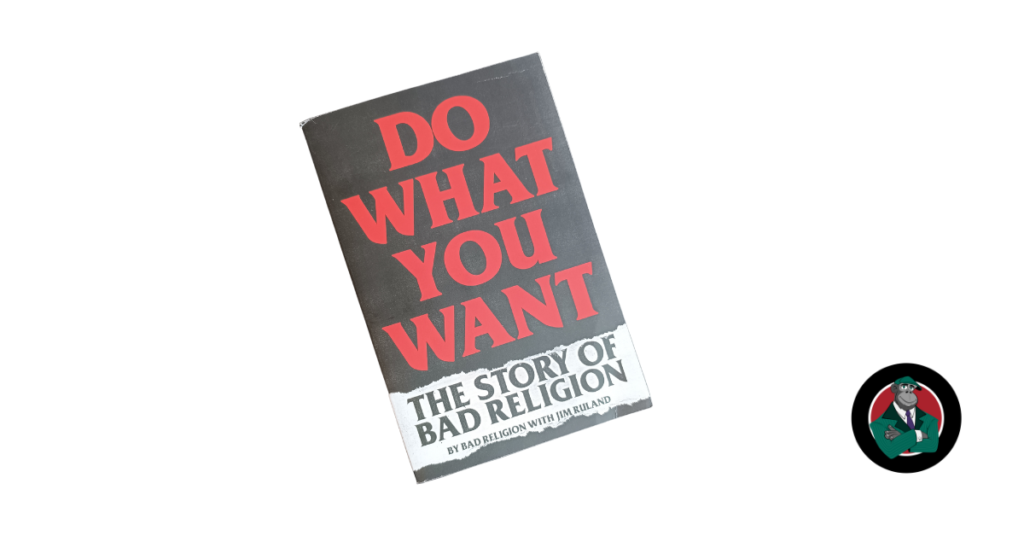
I only knew a few names back in high school – Greg Graffin, the singer and academic; Brett Gurewitz, the guitarist and record producer; Jay Bently, the bassist; Greg Hetson, the other guitarist and incredibly energetic stage presence that I yearned to see but who wasn’t in BR when I saw them, luckily I was able to see him play with The Circle Jerks in Berlin a few years later at the NOFX final tour. The rest of the cast I didn’t really learn about until later. Brian Baker’s name I learned because of the solos he’d shred. But not until I picked up read Do What You Want did I learn about the paths that the band took. I always knew Graffin was the only member who was there the whole time, but I didn’t understand the major contributions the others had in keeping this thing alive, which meant a lot to me because in my dystopian teenage mind there was not much striving for survival.
After reading the book I can now see how different lyrics came from different writers who had different influences in their lives. All of which made a significant impact on mine. Leading me to crave an understanding of how human society worked, with a direction toward the academic. So I studied Politics, Philosophy and Economics. When it came time to enter the formal economy I decided to join the labour force but rather take the path of entrepreneurship. I can see how these choices have been affected by the music I listened to, but only after I’d read the book.
For fans of punk rock or anyone wanting to understand the subculture and how one band can have an indelible impact on the path of musical progression without becoming a household name, this book will entertain you. Jim Ruland threads together stories and quotes from the band themselves along with other objective sources to give the story a meaningful context. I enjoyed it thoroughly and am glad I know more about the people who created the music I love and a band that shaped the very way I perceive the world. But I still don’t care to learn too much more about them. After all, it’s their music I enjoy.

