
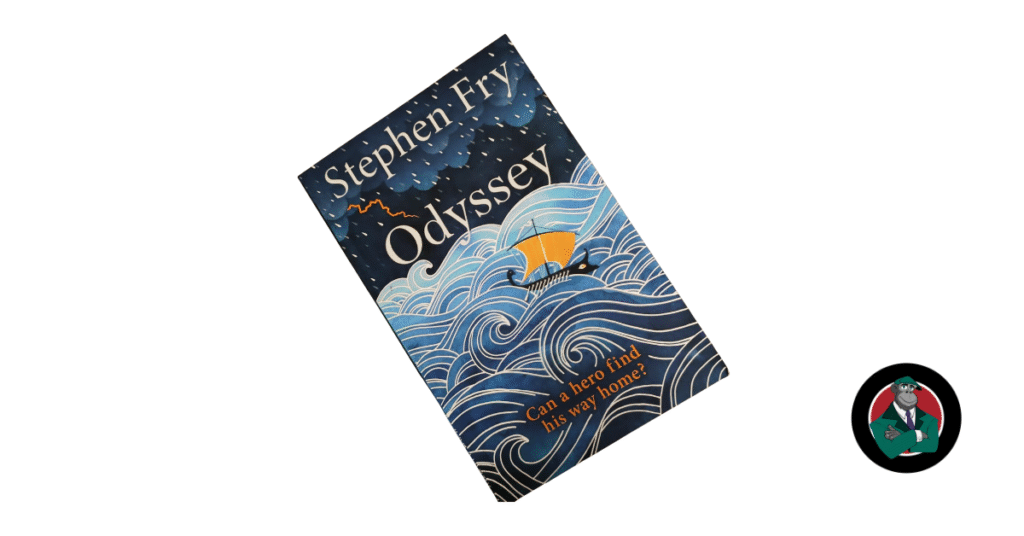
Stephen Fry’s The Odyssey is not merely a retelling of Homer’s epic; it is a sincere invitation to step into the heart of one of the oldest stories we know, one of longing, endurance, wit, and the painful, redemptive pull of home.
Reading it now, in the midst of personal upheaval, I found Fry’s version of The Odyssey not just entertaining or informative, but soul-stirring. This isn’t just Odysseus’ story, it’s mine. And perhaps, if you’ve ever lost your bearings, it’s yours too. This story belongs to all of humanity.
Fry writes with his trademark clarity and humour, never trivialising the tale but making its grandeur accessible. Odysseus becomes both legend and man. Cunning and proud, bruised and longing. As I read, I couldn’t help but see my own struggle in his: someone trying to find their way home after all they knew was swept away.
When Fry reaches the scene where Odysseus, disguised as a beggar, returns to Ithaca after twenty years, he is met not by fanfare but by his old, dying dog, Argus. The moment is tender and tragic. Argus lifts his head to recognise his master…and then dies. When I read that, it moved the foundation of my heart and soul. I had recently put my own old dog down. A companion of many years. I, too, had come home in a way, back to my solitary self, only to find that my most faithful companion could not walk that new road with me. Fry’s telling of this scene is wonderfully restrained, allowing the weight of recognition and loss to speak for itself.
But The Odyssey is not only a tale of grief. It is about surviving grief. Navigating it. And coming out changed.
The gods play constantly in the background of Fry’s retelling, as they do in Homer’s original, and their fickle nature feels less foreign now than ever. I understand how Poseidon’s storms, arbitrary and punishing, can feel personal. The waves he throws at Odysseus echo the chaos that was thrown at me when the person I loved and called my home made choices that cast me out of the life I had and the future I was building. I’ve washed up on unfamiliar shores, unsure of who I am without the person who was my safe haven for so many years. Like Odysseus, I’ve met monsters. Not cyclopes, but depression, anger, disillusionment. And like him, I have clung to what little hope I had, tied myself to the mast when the sirens sang, and kept moving forward.
Fry’s narration captures Odysseus’ duality well: hero and liar, man and myth. There is something comforting about that complexity. Odysseus doesn’t have all the answers. He makes mistakes. He loses his men, his way, and very nearly his life. But he doesn’t give up. That’s the core of the journey. Not heroism in the Hollywood sense, but persistence.
At the heart of this version is also Penelope’s quiet strength. In Fry’s telling, as in Homer’s, she holds the centre while Odysseus wanders. Her final test, the immovable bed she and Odysseus built into the roots of a living tree, is as beautiful as it is poignant. It’s her way of knowing whether the man before her is truly the man she loves.
Fry doesn’t modernise this story with cheap parallels. He lets it breathe and gives it just enough air to feel relevant. He doesn’t make the gods into metaphors, but I can’t help seeing them that way. When I show hospitality, when I bring kindness into a room or offer support to someone who needs it, I am honouring Zeus and his xenia. When I hold back anger and choose peace, I feel I am refusing to let Poseidon rule my seas. And when I write, speak, and strive to be wise, perhaps I am invoking Athena.
These gods live on, not just in Fry’s vivid prose, but in each of us.
What makes this version of The Odyssey stand out is that it respects the grandeur of the epic while grounding it in clear, elegant language. Fry’s wit sparkles, yes, but it never undermines the stakes. His ability to balance reverence and irreverence allows us to both admire and empathise with the characters. It makes the journey feel not just ancient, but intimate.
Since finishing it, I’ve been thinking a lot about what “home” really means. Odysseus comes back to a home that’s changed. That’s been damaged. That’s been waiting. I won’t return to the home I once had. That door has closed. But the longing remains. And perhaps that’s what makes The Odyssey a timeless story. We are all, in some way, looking for a home. Sometimes it’s a place. Sometimes it’s a person. Sometimes, eventually, it’s ourselves.
This book found me at the right time. Fry’s Odyssey reminded me that pain does not erase love, that survival requires cleverness as much as courage, and that the journey toward healing is rarely straightforward.
Like Odysseus, I have many miles left to travel. But I carry his lesson with me now: you can be battered, broken, lost, and still find your way.
Even if, by the time you arrive, home is something you must build anew.

