I must admit I adhere to a bit of the ad hominem fallacy when it comes to taking advice from others. Who you are matters as much as what you have to say, although it shouldn’t. When it comes to improving skills I find it most valuable to learn from folks who have honed those skills themselves. When it comes to writing it’s difficult to argue that there are many others around that can compete with the productive output of Stephen King.
Admittedly, this is the first of his books I have read. Growing up in the 90’s Carrie, The Shining, Cujo, It and The Tommyknockers already existed in audio visual format. Whether film or TV series the material was scary as shit to a youngster. I can still feel my heart getting ready to rev up when I recall the scenes from Tommyknockers that I accidentally saw peaking from behind the couch when I was supposed to be in bed.
So whenever someone suggested I read one of his books I thanked them but declined. The only films based on his books that I watched the whole way through were The Shawshank Redemption and The Green Mile. Both harrowing if not horrific. Needless to say, I knew that Stephen King was a prolific writer without ever having read anything he’d written.
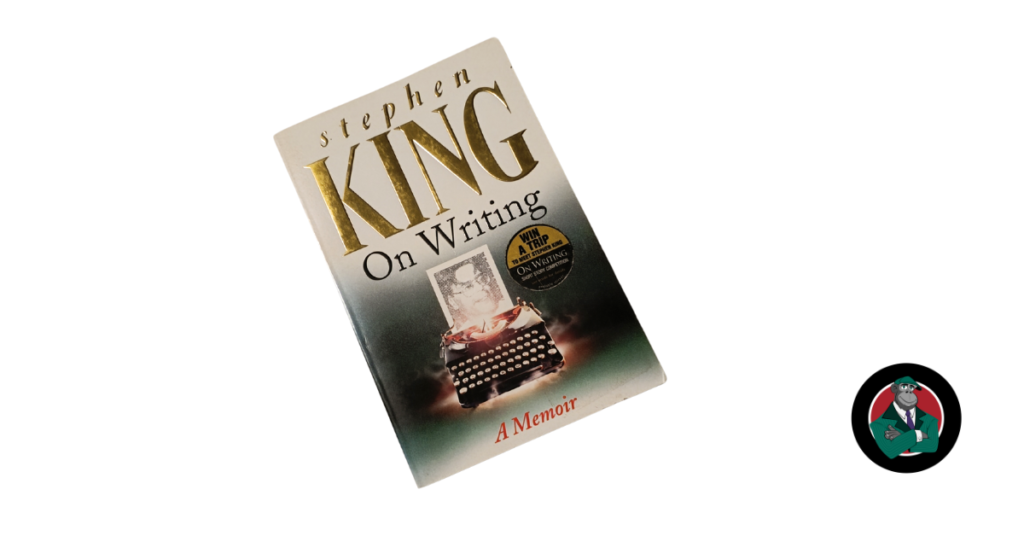
Then one day I stumbled on this book in a second hand store. The cover still boasts a sticker promoting a competition to win a place on a short story writing course with the man and myth himself. Of course that was a couple of decades ago so one has to assume it’s no longer valid. But if you take his own advice in On Writing, the course itself may not be necessary.
If there is one overarching theme from the beginning of this book to the end it is the idea that the only necessity is Truth. Beware the bullshit. Mr King even says as much at the start. There are many books offering advice on almost every topic you can imagine. A large portion of these books are compiled of bullshit. King only references 3 books throughout (all severely lacking in bullshit) and he does provide a reading list at the end as well.
The list is subjective because it’s based on his tastes but much of his advice is immediately actionable and what the business people like to call ‘best practice’. Much like his distaste for adverbs – those words often ending in “-ly” (particularly when attached to dialogue). She said menacingly. He looked unbelievingly. King thinks that these words are the tools of the untalented. Ideally your writing should be good enough that when you describe a scene the reader has an idea in their mind of how the characters are talking when they do, so you don’t need to hammer it home with a didactic boulder at the end.
I believe this to be good advice and have assimilated it into my thinking and practising. Leave the chunky adverbs that beat nonsense into your readers on the editing room floor. Challenge yourself to write vividly enough to convey your meaning without having to ensure it reaches its target with a laser guided missile. That’s just one piece of advice the man gives. There are plenty more.
If you’re an aspiring writer, of any sorts, but very much so if you’re into the idea of writing fiction, then you should probably read this book. It may become one of the well known as time passes by. Up there with the recommended Writers Market and The Elements of Style. I appreciated the brevity of the book and its impact. Stephen was hit by the car so we didn’t have to be. The fact that it says ‘A Memoir’ on the cover is not a coincidence.
As much as this book is a guide on how to write well, it is also placed firmly within the context of Stephen King’s life. How he became the prolific author he is today can be seen through the lens of the childhood experiences he shares. His creative process is also unfolded for all to see. And the fact is that when he worked on this book it was while he was recovering from being hit by a van.
I can see the appeal in his writing from the way he describes this occasion. The vividity is remarkable. Perhaps I’ll pick up a few of his books and give them a bash now that I’m grown and a little less easy to spook. I certainly wasn’t spooked by the assertion that not everyone is capable of being a writer, let alone a legendary one and it is a fact that there are already enough bad books in the world. It’s not only the self-help section that is filled with bullshit. I found this a comforting challenge. Like Bukowski’s poem, So you want to be a writer?
If I am to be a half decent writer I know that it won’t be a simple and easy process. But I do believe I am doing some things right. Stephen King’s first piece of advice is that to be a writer there are two practices to keep up: reading and writing. The reading I do alright with, although my 30 books a year pales in comparison to his 80. The writing I was not so diligent with. Now I aim to write a brief review of each book I read as an exercise in practice. Nothing I publish here is meant to be perfect but it is meant to be one more scrape of the blade along the whetstone.
Anyway, don’t take my advice on writing. Take Stephen King’s and William Strunk’s and the people who put together the Writer’s Market. They’ve got the knowledge, all I’ve got is the finger pointing toward them. That I hope is enough. While others may try to sell you their own advice to keep up their bad habits, I’m only here trying to do my part in stemming the tide of bullshit that threatens to drown out so much brilliance in a pall of dark turds. This is my rage against the dying of the light. Not so ragey any more. Anger and I were too close an acquaintance for us to live together for long.
If you want to be a writer, read and write. It’s in the act of writing that a person becomes a writer. The performance conveys the title. The quality of the writing however comes from a deeper reserve. There may be geniuses among us but they are few and far between and they too had to work hard. Many geniuses worked harder on themselves than on their work. Only a select few didn’t have to work very hard at all. Others were at pains to get even a few words on a page. Nobody can tell you whether to be a writer or not. But you should know that it’s something you’re driven to do by a force deep within your spirit, rather than to line your pockets with cash or get laid. For clarity let me share the words of Mr Bukowski because I don’t think I could put it any better:
So you want to be a writer?
if it doesn’t come bursting out of you
in spite of everything,
don’t do it.
unless it comes unasked out of your
heart and your mind and your mouth
and your gut,
don’t do it.
if you have to sit for hours
staring at your computer screen
or hunched over your
typewriter
searching for words,
don’t do it.
if you’re doing it for money or
fame,
don’t do it.
if you’re doing it because you want
women in your bed,
don’t do it.
if you have to sit there and
rewrite it again and again,
don’t do it.
if it’s hard work just thinking about doing it,
don’t do it.
if you’re trying to write like somebody
else,
forget about it.
if you have to wait for it to roar out of
you,
then wait patiently.
if it never does roar out of you,
do something else.
if you first have to read it to your wife
or your girlfriend or your boyfriend
or your parents or to anybody at all,
you’re not ready.
don’t be like so many writers,
don’t be like so many thousands of
people who call themselves writers,
don’t be dull and boring and
pretentious, don’t be consumed with self-
love.
the libraries of the world have
yawned themselves to
sleep
over your kind.
don’t add to that.
don’t do it.
unless it comes out of
your soul like a rocket,
unless being still would
drive you to madness or
suicide or murder,
don’t do it.
unless the sun inside you is
burning your gut,
don’t do it.
when it is truly time,
and if you have been chosen,
it will do it by
itself and it will keep on doing it
until you die or it dies in you.
there is no other way.
and there never was.
I find this poem far more inspiring than disheartening. Read the best to know what is good. If you read something bad that’s not bad because it can show you what bad is. Knowing what’s good and bad should be a solid start for you to be able to judge your own work. Above all, be honest. With yourself, with your audience, with everyone. It’s something Stephen King mentions more than once: be honest. If you’re being a phoney, you know it and so will everyone else. Align the tatemae and honne.

