
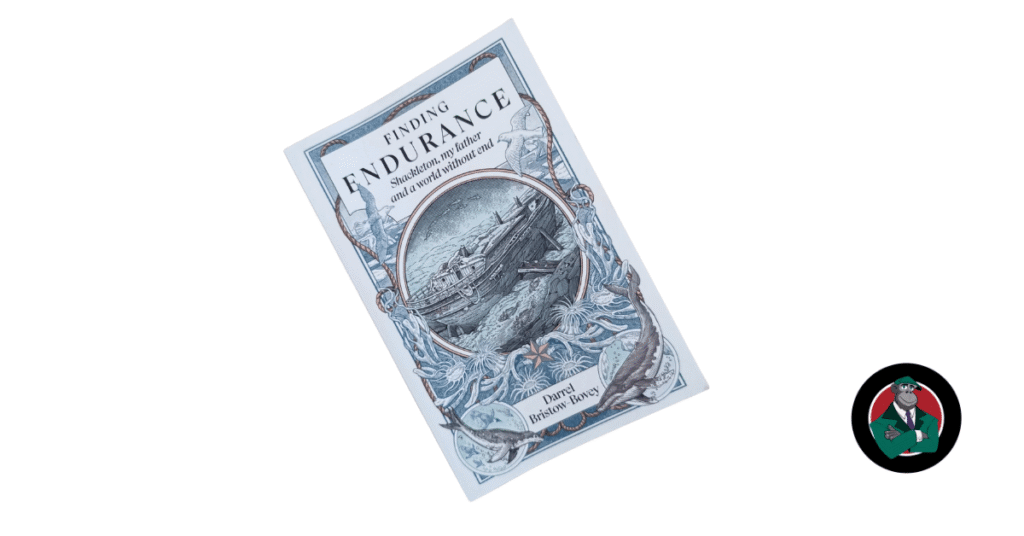
The title caught the eye of my aunt after her parents passed away and she thought the book would resonate with my father who had once been in the navy. She thought it so much that she actually bought it for him twice. So he gave me a copy to read on my travels through Greece.
I began in Belgium and instantly the idea of such rugged adventure intrigued me. I didn’t know much about Shackleton or Scott or Antarctic adventure in any meaningful way. But the book isn’t just about that expedition. It’s also about the writer’s father and mother and life in general. As much as the die hard Shackleton fans may not value these forays into his modern life, I thought they gave the book a deeper dimension. Tying events from a hundred years ago to the world we live in now. It was also intriguing because the author spends much of his time in Athens where I was going to spend some of mine. Turns out it is one of my favourite cities and the people are probably the best part.
Finding Endurance focuses on the expedition by focusing on the boat and its revival in the 21st century. It also speaks to themes of optimism vs pessimism and good vs bad leadership. The fact that nobody died on Shackleton’s mission while everyone perished on Scott’s says a lot. The author also makes some brief forays into philosophical thought particularly about what it means to see the world as a never-ending adventure as opposed to a goal to be reached. A few references to Peter Pan do their metaphorical work quite well.
The book was easy to read even when the subject matters turned somewhat gory. When men have to kill their dogs and cats, those brilliant companions whose loyalty we have never done enough to deserve throughout human history is a classic case of the macabre subject matters that gets covered. But between the struggles and downright madness of it all the author finds those bright spots that it is the artist’s duty to show to the world.
What struck me most was how Bovey Bairstow writes with both detachment and tenderness. His prose has the clear curiosity of a historian, but also the ache of a son trying to understand his father. The way he weaves together Shackleton’s doomed yet triumphant expedition with his own family’s history gives the narrative a dual heartbeat — one pulsing through the ice floes of the past, the other beating through the quiet, modern reflections of grief and endurance. It’s rare to find a book that makes you care equally about a ship, a crew, and a family, but this one manages it.
In many ways, Finding Endurance is less about exploration in the geographical sense and more about the inner landscapes of courage and loss. It asks, perhaps without ever saying it outright, what keeps people going when everything freezes over — whether that’s the Antarctic sea or the aftermath of a parent’s death. The title begins to feel less like a nod to the ship and more like a meditation on how endurance itself is rediscovered in every generation.
There are also subtle questions of masculinity and legacy running through the text. Shackleton’s form of leadership, pragmatic, humane, and adaptable, contrasts not only with Scott’s doomed rigidity but also with the emotional stoicism of the author’s own father. Reading those parallels reminded me that heroism doesn’t always look like conquest; sometimes it’s quiet persistence, the kind that doesn’t make headlines but keeps families, and even small boats, afloat.
I also appreciated the book’s sense of pace. It drifts like the ice at times, slow, deliberate, but never stagnant. You come to understand that the point isn’t to rush toward the end of the story but to stay with it, to feel the temperature of each decision, each failure, each small miracle that kept the crew alive. In that way, it feels less like reading a biography and more like being part of a living conversation between eras.
By the time I finished it, sitting in a café in Athens and watching the afternoon sun fall over the Acropolis, I realised how fitting it was to read it there. The endurance Bairstow writes about isn’t just that of explorers trapped in ice, it’s the endurance of memory, of art, of human curiosity that survives centuries. Greece, with its layers of myth and ruin and resilience, felt like the perfect mirror for that idea.
Finding Endurance left me feeling both humbled and strangely uplifted. It reminded me that no matter how inhospitable the conditions, physical or emotional, there is always something in us that pushes forward, that refuses to sink. Shackleton’s men found it in each other. The author found it in writing. And for readers, that endurance becomes something we can carry quietly within ourselves, long after the last page is turned.

